


Sunday night. 10:47 PM. The realization hits like cortisol ice water:
The presentation. Tomorrow. Monday morning. 9 AM.
I’d forgotten to prepare.
Not entirely forgotten—I’d known about it for two weeks. But I hadn’t blocked time. Hadn’t gathered the data. Hadn’t built the deck. And now, Sunday night, with the week looming like a tsunami, I faced a choice: stay up until 2 AM scrambling, or walk into Monday unprepared.
I chose scrambling. Built a mediocre deck. Delivered a mediocre presentation. Felt the cortisol spike from the moment my alarm went off until I finally closed my laptop at 8 PM, exhausted and resentful.
This wasn’t an isolated incident. This was every week. Sunday night dread. Monday morning chaos. Wednesday wondering how I’d survive until Friday.
Here’s what I didn’t understand then: This pattern doesn’t happen because you’re disorganized or lazy. It happens because you don’t have a weekly review system. But here’s the trap most people fall into: traditional weekly reviews take 3 exhausting hours to review 100% of your activities—so you skip them.
What if you reviewed only your 20%—the activities that generate 80% of your results—in 30 minutes? And actually did it every week?
That’s the Pareto Protocol Weekly Review. Thirty minutes. Five phases. Every Sunday evening. The hinge between weekly chaos and daily sovereignty.
Before we continue, grab the free template so you can implement immediately: [Get The 30-Minute Weekly Review Template]
No spam. Just the protocol.
Why Weekly Reviews Fail (And Why You Skip Them)
You know you should do a weekly review. You’ve read the productivity books. You’ve tried the systems. Michael Hyatt’s Weekly Preview. David Allen’s GTD Weekly Review. Tony Robbins’s RPM planning.
And they all say the same thing: Take time each week to reflect, plan, and organize.
So why don’t you do it?
Because traditional weekly reviews are exhausting.
They ask you to review everything: every project, every task, every email, every commitment, every calendar entry, every goal. You’re reviewing your 100%—all the activities in your life—trying to get clarity on all of them simultaneously.
Research from Harvard Business School demonstrates that reflection improves performance by 23%—but only if you actually do it consistently. And here’s the problem: when your weekly review takes 2-3 hours, you don’t do it consistently. You skip it. You tell yourself you’ll do it “next week.”
And then Monday arrives.
Unprepared. Unplanned. Chaos mode.
The forgotten presentation was just one example. There were dozens of others:
The client deadline I missed because I hadn’t reviewed my commitments. The gym session I skipped because I hadn’t blocked the time. The writing project that sat untouched for three weeks because I never planned when to work on it. The networking event I agreed to attend (my 80%) that drained my energy when I should have been working on revenue-generating activities (my 20%).
Each time, the pattern was identical:
Sunday: No weekly review. Too tired. Too busy. “I’ll just wing it.”
Monday morning: Panic. Scramble. Cortisol spike. Heart racing. Mental fog. Rushing to catch up before the day even starts.
Monday-Friday: Reactive mode. Putting out fires. Responding to urgencies. Never getting to the important work—my 20%—because I hadn’t protected time for it.
Sunday night: Exhaustion. Dread. The realization: “I did this to myself. Again.”
The cost wasn’t just stress. It was opportunity.
Every week I didn’t review was a week I drifted back to my 100%—doing all the things, including the 80% that didn’t matter. The client work that generated 20% of revenue but consumed 60% of my time. The meetings that felt productive but accomplished nothing. The email responses that could have waited or been deleted entirely.
Without a weekly review, you drift back to your 100%. And Monday becomes chaos.
The Origins: Hyatt’s Weekly Preview + Allen’s GTD Weekly Review
The concept of a weekly review isn’t new. Two productivity titans pioneered comprehensive systems:
Michael Hyatt’s Weekly Preview
Michael Hyatt’s Full Focus Planner popularized the “Weekly Preview”—a structured planning session designed to create clarity before the week begins.
Hyatt’s system includes five components:
Review last week: What worked, what didn’t
Assess your Big 3 goals: Are you making progress on quarterly objectives?
Identify this week’s Big 3: What three outcomes matter most this week?
Plan your Ideal Week: Time block your priorities
Schedule your weekly rhythm: Include margin, rest, relationships
It’s brilliant. If you do it, you start Monday with clarity instead of chaos. You know what matters. You’ve blocked time for your priorities. You’re proactive, not reactive.
The problem: Hyatt’s Weekly Preview reviews all your projects and all your goals. If you have 12 active projects and 8 quarterly goals, you’re reviewing 20 things. It takes 60-90 minutes minimum—often longer if your life is complex.
And when something takes 90 minutes, you skip it.
David Allen’s GTD Weekly Review
David Allen’s Getting Things Done methodology includes the Weekly Review as a core component. Allen breaks it into three phases:
Get Clear:
Process all inboxes (email, physical, digital)
Review all project lists
Update all task lists
Clear all loose ends
Get Current:
Review your calendar (past and future)
Review waiting-for lists
Review someday/maybe lists
Get Creative:
Review goals
Generate new ideas
Plan next week
Allen’s system is comprehensive. Thorough. Designed to create what he calls “mind like water”—complete clarity and readiness.
The problem: Allen’s 11-step weekly review takes 2-3 hours. It reviews everything in your GTD system—every project, every next action, every waiting-for item, every someday/maybe idea. You achieve comprehensive clarity.
If you do it.
Which you don’t. Because it takes 3 hours.
The Comparison:
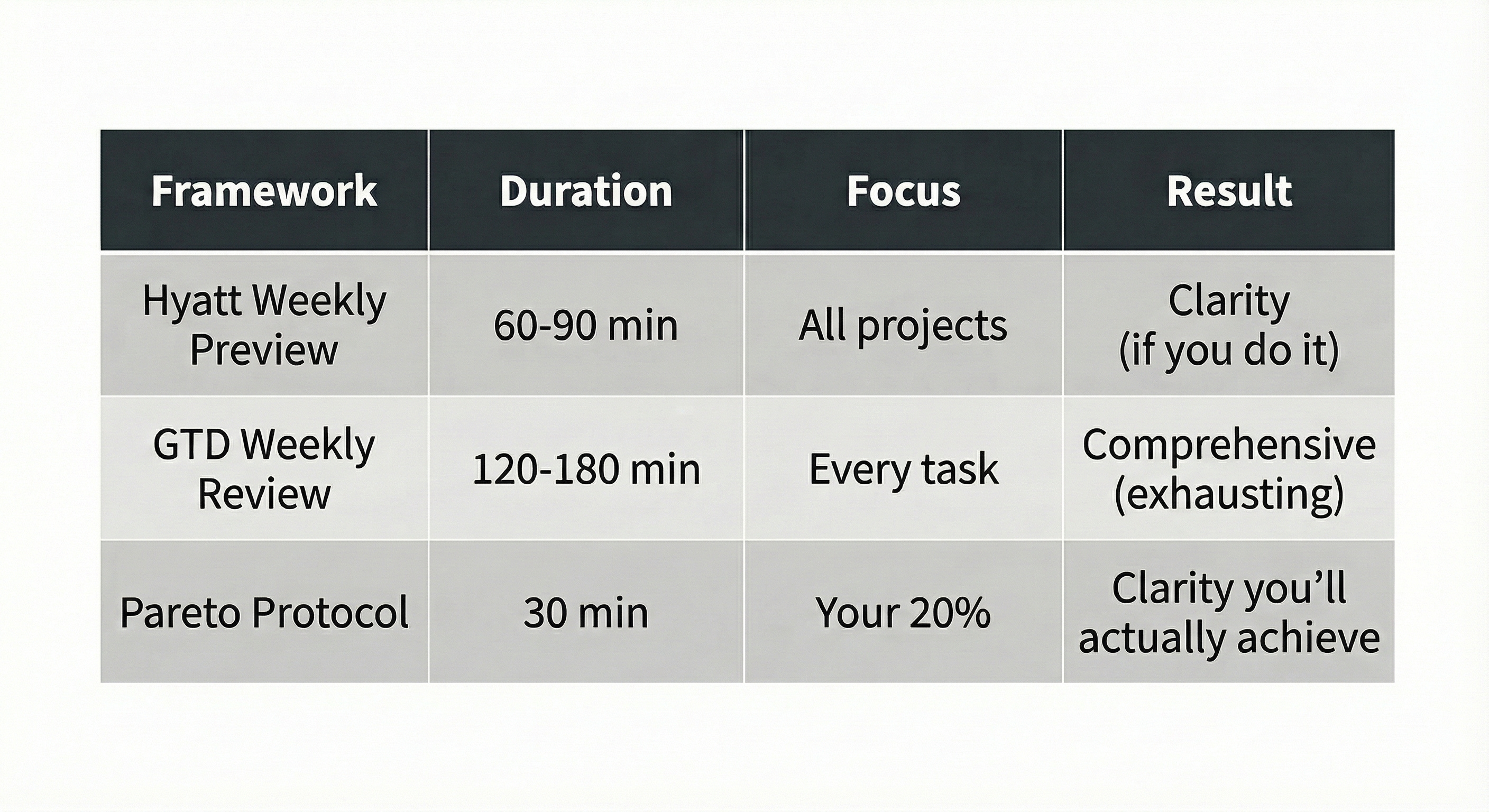
Both Hyatt and Allen teach powerful systems. But they share a fatal flaw: they review your 100%.
And reviewing your 100% is exhausting. So you skip it. And then Monday is chaos. Again.
The Pareto Protocol Adaptation
Here’s the insight that changed everything:
You don’t need to review everything to gain clarity. You need to review the 20% that matters.
The Pareto Protocol keeps what works from Hyatt and Allen:
Weekly rhythm (review every Sunday)
Planning before the week starts (proactive, not reactive)
Reflection on past week (learn from data)
Calendar architecture (block time for priorities)
But it eliminates what makes their systems exhausting:
Reviewing all projects (just review your Big 3)
Processing all inboxes (just ensure your 3 Must-Dos are captured)
Updating all task lists (just confirm your 20% activities are scheduled)
The core shift: Review your 20%, not your 100%.
Time saved: 30 minutes vs. 3 hours.
Completion rate: Every week vs. “next week” (never).
The Pareto Protocol doesn’t review everything. It reviews the 20% that matters—in 30 minutes. And because you actually do it every week, it produces better results than the comprehensive systems you skip.
Why Is Weekly Review Important?
The weekly review serves as the hinge between daily tactics and quarterly strategy.
Daily: You execute your 3 Must-Dos (from your 20%)
Weekly: You choose next week’s 3 Must-Dos and eliminate 80% creep
Quarterly: You re-audit your 20% and design the next 90 days
Without the weekly hinge, you drift. You forget what matters. You say yes to 80% activities. You lose track of your Big 3 quarterly goals. By the time you realize you’ve drifted, you’re three weeks off course.
The weekly review prevents drift. Every Sunday, you recalibrate. You review the data from last week. You identify where you stayed in your 20% and where you slipped into your 80%. You course-correct before the drift becomes catastrophic.
Hal Hershfield’s research at UCLA Anderson School reveals that people who feel more connected to their future selves make better long-term decisions. Weekly Future Self reflection increases continuity—you’re checking in with your Future Self every seven days, asking: “Did I serve you last week? Will next week’s choices serve you?”
For the Pareto Protocol specifically, the weekly review:
Tracks your Freedom Three metrics (Time Autonomy, Energy Surplus, Freedom Goal Progress)
Identifies when your 80% creeps back in
Ensures your 3 Must-Dos come from your 20%, not random urgencies
Prevents the Monday chaos that costs you hours of cortisol-fueled scrambling
Thirty minutes on Sunday prevents ten hours of chaos Monday through Friday.
That’s the math.
The Breakthrough
I discovered the 30-minute protocol by accident.
It was Week 4 of attempting Hyatt’s Weekly Preview. I’d completed it once in three weeks—and that one time took me 2 hours because I got lost in reviewing all my projects. By Week 4, I was exhausted just thinking about it.
Sunday evening arrived. I told myself: “Just review the essential stuff. Your Big 3. Your Freedom Three. The next week’s priorities. That’s it.”
I set a timer for 30 minutes.
Phase 1: Pulled last week’s Freedom Three scores. Calculated averages. Saw immediately where I’d drifted (low Time Autonomy Wednesday-Thursday—too many meetings, my 80%).
Phase 2: Wrote down three wins (my 20% working) and two lessons (my 80% creeping back).
Phase 3: Identified next week’s 3 Must-Dos from my 20% pool. Applied Future Self filter. Done.
Phase 4: Blocked calendar time for those three tasks. Blocked “No Meeting” windows.
Phase 5: Scanned new commitments. Identified one 80% activity to decline.
Timer went off. Thirty minutes. Complete.
And here’s what shocked me: I felt as clear as I had after the 2-hour comprehensive review. Maybe clearer. Because I’d focused on my 20%—the activities that actually move my life forward—instead of getting lost in reviewing every project and task.
The next Sunday, I did it again. Thirty minutes. Done.
Six Sundays in a row. Then twelve. Then twenty-four.
The consistency was the transformation. Not the comprehensiveness. The consistency.
This weekly review system is the tactical implementation of the frameworks in The Architect: Building Your Sovereign Operating System (Book II). Preorder coming soon!
The Complete 5-Phase Pareto Protocol Review (30 Minutes)

The 5-Phase Pareto Protocol Weekly Review:
Last Week Freedom Three Review (5 min) - Aggregate Time Autonomy, Energy Surplus, Freedom Goal Progress
Wins and Lessons (5 min) - What worked (your 20%), what didn’t (your 80% creeping back)
Next Week’s 3 Must-Dos (10 min) - Choose from your 20% pool, Future Self filter
Calendar Architecture (5 min) - Block time for 3 Must-Dos, block “No” time for 80%
Pareto Check (5 min) - Identify drift back to 100%, new commitments to audit
That’s it. Five phases. Thirty minutes total.
Let me break down each phase.
Phase 1: Last Week Freedom Three Review (5 minutes)
What to do:
Pull up your daily Freedom Three scores from last week. These are the three metrics that tell you whether you’re living in your 20% or drifting to your 100%:
Time Autonomy % - Percentage of your day spent on your 20% activities
Energy Surplus - Did you end the day with more energy than you started? (1-10 scale)
Freedom Goal Progress - Did you make measurable progress on your sovereignty goals? (Yes/No)
Calculate weekly averages:
Time Autonomy: Average of 7 days
Energy Surplus: Average score 1-10
Freedom Goal Progress: How many days showed progress (0-7)
The Pareto Protocol Question: “Did I live my 20% last week?”
Why this matters:
These three metrics are your dashboard. They tell you immediately if you stayed in your 20% or slipped into your 80%.
If Time Autonomy <60%: You’re doing too much 80%. Your calendar is controlled by others’ priorities, not yours.
If Energy Surplus <7/10: You’re depleted. The activities filling your week are energy vampires—your 80%.
If Freedom Goal Progress <5 days: You’re busy but not advancing sovereignty. You’re optimizing your 80% instead of executing your 20%.
How to track:
Paper system: Freedom Three daily log sheet (print the template, fill out each evening)
Digital system: Spreadsheet with seven daily entries, auto-calculate weekly average
Notion/Obsidian: Database with daily entries, formula columns for averages
For complete Freedom Three explanation and tracking templates, see the Freedom Three metrics explained in detail.
5-minute execution:
Minute 1: Pull last week’s seven daily scores
Minutes 2-4: Calculate averages, identify patterns
Minute 5: Write one insight: “Low energy Tuesday-Thursday—discovered I’d scheduled three 80% meetings (networking events that drained me instead of revenue-generating client work)”
That’s Phase 1. Done.
Phase 2: Wins and Lessons (5 minutes)
What to do:
Identify three wins from last week (evidence your 20% is working) and one to two lessons (evidence your 80% crept back in).
Pareto Protocol framing:
Wins = Evidence of Your 20%
“Completed Big 3 Monday, Wednesday, Friday”
“Defended morning writing hour 6 out of 7 days”
“Declined networking event (my 80%) to work on course launch (my 20%)”
“Finished client proposal on Tuesday (income-generating 20%)”
Lessons = Evidence of 80% Drift
“Said yes to coffee meeting with acquaintance (energy vampire, not strategic relationship)”
“Checked email first thing Monday morning (lost 90 minutes to inbox instead of defending writing hour)”
“Attended webinar Thursday (felt like professional development but was really procrastination from my 20%)”
Why this matters:
Wins reinforce what’s working. When you write down “Defended morning hour 6/7 days,” your brain codes that as success. You’re more likely to repeat it.
Lessons identify drift before it becomes catastrophic. That coffee meeting with an acquaintance? If you don’t name it as 80% drift, you’ll say yes to three more next week. By naming it: “That was my 80%—not strategic, not energizing, not aligned with my 20%,” you create awareness. Next time the invitation comes, you’ll remember: “Last time I did this, I labeled it as 80% drift. Decline.”
5-minute execution:
Minutes 1-2: Review last week’s calendar and task completions. Write down three wins.
Minutes 3-4: Review what didn’t work or what drained energy. Write down one to two lessons.
Minute 5: Note the pattern: “I drift to 80% when I don’t block calendar proactively. Meetings fill empty space.”
Example from my Sunday review:
Wins (My 20% Working):
Completed Pareto Protocol posts Tuesday and Friday (writing = my 20%)
Gym 5 days (health foundation = my 20%)
Declined three meeting requests (protected my 20%)
Lessons (My 80% Creeping Back):
Said yes to podcast interview that wasn’t aligned with book launch goals (felt like opportunity but was distraction from my 20%)
Spent 90 minutes researching productivity tools Wednesday afternoon (optimization obsession = my 80%)
Pattern identified: “I drift to 80% when I mistake ‘interesting’ for ‘important.’”
That awareness prevents repeating the mistake next week.
Phase 3: Next Week’s 3 Must-Dos Identification (10 minutes)
This is the longest phase because it’s the most critical. You’re choosing what matters for next week.
What to do:
Choose three Must-Dos for next week from your 20% pool. These aren’t random tasks. They’re the three activities from your 20% that, if completed, will make next week successful regardless of what else happens.
The Pareto Protocol Question:
“Which three tasks from my 20% would my Future Self never forgive me for not completing next week?”
How to identify your 3 Must-Dos:
Step 1: Review your Pareto Protocol Audit (your known 20% activities)
You’ve already conducted the step-by-step Pareto Protocol Audit process and identified your 20%—the activities that generate 80% of your results across domains (health, wealth, freedom).
Your 20% pool might include:
Health: Gym sessions, meal prep, sleep consistency
Wealth: Revenue-generating client work, course creation, strategic networking
Freedom: Writing, location independence preparation, automated wealth setup
Pull up that list. Your 3 Must-Dos come from this pool, not from random urgencies.
Step 2: Scan upcoming obligations (calendar review)
Look at next week’s calendar. What’s already scheduled? Any non-negotiable commitments? Client deadlines? Travel? Family obligations?
Context matters. If you have three all-day meetings scheduled Wednesday-Friday, your capacity for additional Must-Dos is limited. Choose accordingly.
Step 3: Apply the Future Self filter
For each candidate activity, ask: “Will my Future Self (5 years out) thank me for completing this next week?”
If yes: It’s your 20%. Consider it.
If no: It’s your 80%. Delete it or delegate it.
Example filtering:
“Write two Pareto Protocol posts” → Future Self: “Yes, this builds the platform that creates sovereignty.” ✓
“Reorganize file system” → Future Self: “No, this is optimization busywork that doesn’t matter.” ✗
“Complete client proposal for strategic partnership” → Future Self: “Yes, this generates revenue and aligns with wealth 20%.” ✓
“Attend networking event for local entrepreneurs” → Future Self: “No, these events drain energy and rarely produce strategic relationships.” ✗
Step 4: Ensure domain balance
Your 3 Must-Dos should span the three sovereignty domains when possible:
One from Health (your physical foundation)
One from Wealth (your financial sovereignty)
One from Freedom (your location/time autonomy)
Not every week will have perfect balance. Some weeks are wealth-heavy (client deadlines). Some weeks are health-focused (recovering from burnout). That’s fine. But aim for balance over time.
Example Next Week’s 3 Must-Dos:
Must-Do #1 (Health): Complete 5 gym sessions (strength training = my health 20%)
Success criteria: 5 sessions of 45 minutes each, progressive overload protocol
Scheduled: Monday 6-7am, Tuesday 6-7am, Thursday 6-7am, Friday 6-7am, Saturday 8-9am
Must-Do #2 (Wealth): Finish and deliver client proposal for $15K strategic partnership
Success criteria: 12-page proposal, financial projections, deliverables timeline
Scheduled: Tuesday 9am-1pm (blocked - no meetings), Wednesday 9am-12pm
Must-Do #3 (Freedom): Write and publish two Pareto Protocol posts (series Posts #11-12)
Success criteria: Two posts, 4,500 words each, published Monday/Thursday
Scheduled: Monday 5-9am (Post #11), Thursday 5-9am (Post #12)
Everything else is my 80%. If it’s not one of these three, it gets declined, delegated, or deleted.
10-minute execution:
Minutes 1-3: Scan calendar, list candidate activities from 20% pool
Minutes 4-7: Apply Future Self filter to each candidate, narrow to three
Minutes 8-10: Write final 3 Must-Dos with specific success criteria (what “complete” looks like)
For comprehensive guidance on identifying your 3 Must-Dos, see how to identify your 3 Must-Dos from your 20%.
Phase 4: Calendar Architecture (5 minutes)
What to do:
Now that you know your 3 Must-Dos, block time for them on your calendar. And block “No” time to protect against your 80%.
Pareto Protocol principle: “Calendar your 20%, block your 80%.”
How to block:
For each Must-Do: Schedule specific time blocks (day + time + duration)
Don’t leave this vague. “I’ll do it sometime this week” = it won’t happen. Block exact times:
Monday 6-7am: Gym (Must-Do #1)
Tuesday 9am-1pm: Client proposal (Must-Do #2) [BLOCKED - No meetings, no email]
Thursday 5-9am: Write Pareto post (Must-Do #3) [BLOCKED - No interruptions]
For 80% protection: Block “No” windows
These are calendar blocks that say “No” to everything that’s not your 20%:
“No Meetings Before 10am” (protects morning deep work)
“No Email 5-9am” (protects writing hours)
“No Calls Friday Afternoon” (protects weekly review prep)
Scan existing calendar: Identify 80% to cancel
Look at what’s already scheduled next week. Any meetings, calls, or commitments that are your 80%? Cancel them. Decline them. Reschedule them for a month out (and then cancel them again).
Example week architecture after Phase 4:
Monday:
6-7am: Gym (Must-Do #1) [BLOCKED]
9am-12pm: Client work [BLOCKED - No meetings]
2-3pm: Team sync (necessary 20%)
Tuesday:
6-7am: Gym (Must-Do #1) [BLOCKED]
9am-1pm: Client proposal (Must-Do #2) [BLOCKED - No interruptions]
3-4pm: Strategic call with partner
Wednesday:
9am-12pm: Client work
2-4pm: Existing commitment (can’t move)
Thursday:
5-9am: Write Pareto post (Must-Do #3) [BLOCKED - No email, no calls]
6-7am within that block: Gym (Must-Do #1)
10am-12pm: Client work
Friday:
6-7am: Gym (Must-Do #1) [BLOCKED]
9am-12pm: Client work
2-4pm: Weekly review prep (scan loose ends)
Saturday:
8-9am: Gym (Must-Do #1 - fifth session) [BLOCKED]
Rest of day: Family, rest, recharge
5-minute execution:
Minutes 1-2: Block specific times for your 3 Must-Dos (drag calendar blocks)
Minutes 3-4: Block “No” windows (no meetings, no email, no calls during your 20%)
Minute 5: Scan existing calendar—identify any 80% meetings to cancel or decline
The goal: Your 20% has protected time. Your 80% has no space to creep in.
Phase 5: Pareto Check (5 minutes)
What to do:
Final phase: maintenance. Check for 80% drift and new commitments that need auditing.
The Pareto Protocol questions:
1. “Did I say yes to anything last week that’s actually my 80%?”
Review last week. Any new commitments? New projects? New meetings you agreed to attend?
For each one, ask: “Is this my 20% or my 80%?”
If it’s your 80%, cancel it now. Send the email: “I’ve reviewed my priorities and need to decline. Thank you for understanding.”
2. “Are any old 80% activities creeping back?”
Check your calendar and task list. Any 80% activities that you eliminated months ago but are somehow back?
Common 80% creep:
Networking events you’d stopped attending
Email newsletters you’d unsubscribed from (but got re-added)
Side projects you’d abandoned (but someone asked you to revive)
Meetings you’d declined (but got re-invited to)
If you spot 80% creep, eliminate it again. Unsubscribe again. Decline again. Delete the project again.
3. “Is my current 20% still my actual 20%?”
Your 20% evolves. What mattered last quarter may not matter this quarter.
If you notice declining results from an activity you labeled as 20%, it may have shifted to 80%. Time to re-audit.
When to conduct full Pareto Protocol Audit:
If Freedom Three scores drop below 6/10 for two consecutive weeks
If you feel chronic drift (busy but not advancing sovereignty)
Every 90 days (quarterly recalibration, see the quarterly Pareto Protocol recalibration) - Coming Soon!
5-minute execution:
Minutes 1-2: Review new commitments from last week—are they 20% or 80%?
Minutes 3-4: Scan calendar and task lists—any old 80% creeping back?
Minute 5: Gut check—is my current 20% still serving me? (If no: note “Conduct Pareto Audit next Sunday”)
That’s Phase 5. You’re done.
Want the complete 30-Minute Protocol as a downloadable template with daily prompts and tracking sheets?
Get instant access:
Join 2,000+ people using this template weekly.
How Long Should a Weekly Review Take?
For the Pareto Protocol: 30 minutes.
Because you’re reviewing your 20%, not your 100%.
Traditional weekly reviews (Hyatt’s, Allen’s) take 2-3 hours because they review everything:
All projects (10-20 projects)
All tasks (50-200 tasks)
All emails (hundreds of messages)
All goals (8-12 quarterly goals)
All commitments (meetings, calls, obligations)
That’s comprehensive. That’s also why you skip it.
The Pareto Protocol reviews:
Your 3 Big quarterly goals (not all 12 someday/maybe goals)
Last week’s 3 Must-Dos completion (not all 50 tasks)
Next week’s 3 Must-Dos from your 20% (not your entire project list)
Your Freedom Three metrics (not every metric you could track)
Your calendar for 80% drift (not every email and task)
That takes 30 minutes. And because it takes 30 minutes, you do it every week. And because you do it every week, it works.
Consistency beats comprehensiveness.
Common Obstacles & Troubleshooting
“I don’t have 30 minutes.”
Yes, you do. You waste two hours on your 80% every single day.
Last week, you spent:
90 minutes in meetings that accomplished nothing (your 80%)
60 minutes scrolling social media “for work” (your 80%)
45 minutes reorganizing your file system (your 80%)
30 minutes researching productivity tools you’ll never use (your 80%)
That’s four hours of 80% activities. You have 30 minutes for your weekly review.
The real resistance isn’t time. It’s that reviewing your week forces you to confront how much time you wasted on your 80%. That’s uncomfortable. Do it anyway.
“I skip it anyway.”
Because you’re still trying to review your 100%, not your 20%.
Go back to Phase 1. You’re not reviewing all your tasks. You’re reviewing three metrics. That’s it.
Phase 2: Not reviewing every win and lesson. Three wins, two lessons. Five minutes.
Phase 3: Not choosing from all possible tasks. Choosing from your known 20% pool. Ten minutes.
If you’re still skipping it, you haven’t eliminated enough. Your 20% pool is still too large. Conduct the step-by-step Pareto Protocol Audit process and eliminate more aggressively.
“My week changes too much to plan ahead.”
That’s exactly why you need a weekly review.
If your week changes constantly, you need the weekly recalibration even more. Every Sunday, you reassess. You see what changed. You adjust your 3 Must-Dos accordingly. You re-block your calendar.
Without the weekly review, you’re reacting to changes as they happen—chaos mode. With the weekly review, you’re adjusting proactively every seven days—sovereignty mode.
“I feel guilty doing less.”
That’s your Ghost talking. That’s the Nice Guy Operating System saying: “If you’re not doing everything, you’re not valuable.”
Reframe: You’re not doing less. You’re doing your 20%—the activities that actually matter.
Your Future Self doesn’t care that you attended three networking events, reorganized your email folders, and completed 47 minor tasks. Your Future Self cares that you completed your 3 Must-Dos—the 20% that builds sovereignty.
Cal Newport advocates for a shutdown ritual that creates cognitive closure at the end of each workday. The weekly review provides that same closure at the week level—you’ve reviewed what matters, planned what’s next, and released what doesn’t serve you.
That’s not guilt. That’s sovereignty.
Tool Integration
How to Conduct the Review in Your Chosen Stack
The 5-phase protocol works regardless of your tools. Here’s how to execute it in three common setups:
Paper System (Full Focus Planner or Pareto Protocol Planner)
Phase 1: Freedom Three Review
Use: Weekly Freedom Three log sheet (one page with 7 daily entries)
Action: Review daily scores, calculate weekly averages by hand or with calculator
Location: Front of your weekly section
Phase 2: Wins and Lessons
Use: Journal page or dedicated “Weekly Reflection” section
Action: Write three wins, two lessons in bulleted list
Location: End of weekly section or separate reflection journal
Phase 3: Next Week’s 3 Must-Dos
Use: Weekly planning page (usually the left page of two-page spread)
Action: Write your 3 Must-Dos at top of page with success criteria
Location: First page of new week
Phase 4: Calendar Architecture
Use: Weekly calendar spread (usually right page of two-page spread)
Action: Block time for each Must-Do, shade or cross-hatch “No” blocks
Visual: Use highlighter or different pen color for blocked times
Phase 5: Pareto Check
Use: Notes section or bottom of weekly planning page
Action: Review calendar for 80% creep, write “Audit needed?” if major drift
Location: Margins or dedicated “Notes” area
Advantages: Tactile, no digital distractions, satisfying to physically cross out 80%
Disadvantages: No auto-calculation, can’t search past weeks easily
Digital System (Asana Example)
Phase 1: Freedom Three Review
Use: Asana project titled “Freedom Three Tracking” with recurring tasks
Action: Each day has a task with custom fields (Time Autonomy %, Energy Surplus 1-10, Freedom Progress Yes/No)
View: Board view or Calendar view, filter to last 7 days, export to spreadsheet for average calculation
Phase 2: Wins and Lessons
Use: Weekly Review task (recurring every Sunday) with subtasks
Action: Add subtasks: “Win 1:”, “Win 2:”, “Win 3:”, “Lesson 1:”, “Lesson 2:”
Location: “Weekly Review” project or section in your main project
Phase 3: Next Week’s 3 Must-Dos
Use: Create three tasks in your main project, tag with custom field “Must-Do” or section “This Week’s Big 3”
Action: Add detailed descriptions with success criteria, assign due dates
View: Filter to “Must-Do” tag to see only your 3, hide everything else
Phase 4: Calendar Architecture
Use: Asana Calendar view or sync to Google Calendar
Action: Create time-block tasks (e.g., “BLOCKED - Writing Time 5-9am”) with no assignee or assigned to “Calendar Block”
Visual: Color-code Must-Dos vs. Blocks vs. Regular tasks
Phase 5: Pareto Check
Use: Scan all active tasks, look for newly added commitments
Action: Tag as “20%” or “80%” using custom field, archive/delete all “80%” tags
Maintenance: Run “80% Audit” search monthly
Advantages: Searchable, auto-syncs to calendar, can share with team if needed
Disadvantages: Requires discipline not to add 47 tasks (stick to 3 Must-Dos)
Hybrid System (Notion + Analog)
Phase 1: Freedom Three Review
Use: Notion database with daily entries (Date, Time Autonomy %, Energy Surplus, Freedom Progress)
Action: Weekly rollup property calculates averages automatically
View: Calendar view for daily entries, Table view for weekly rollup
Phase 2: Wins and Lessons
Use: Paper journal (physical notebook)
Action: Handwrite three wins and two lessons
Why hybrid: Reflection feels more meaningful handwritten, research supports this
Phase 3: Next Week’s 3 Must-Dos
Use: Notion page titled “Week of [Date]” with checklist
Action: Three checkbox items with nested bullets for success criteria
Template: Duplicate from “Weekly Template” page
Phase 4: Calendar Architecture
Use: Google Calendar (synced from Notion if using Notion Calendar integration)
Action: Block time directly in Google Calendar, use color coding
Colors: Red = Must-Do time, Blue = BLOCKED - No meetings, Gray = Regular commitments
Phase 5: Pareto Check
Use: Notion database “Commitments Audit” with property “20% or 80%”
Action: Add any new commitments from last week, tag as 20% or 80%, archive 80%
Advantages: Combines benefits of analog (journal reflection) and digital (auto-calculations, searchability)
Disadvantages: Two systems to maintain, potential for friction if not integrated smoothly
For complete tool selection guidance, see the complete tool selection framework.
Monthly Aggregation (4-Week Pattern Analysis)
Every four weeks, review your four weekly reviews. This is a 15-minute monthly meta-review.
What to look for:
Freedom Three trends:
Is Time Autonomy increasing or decreasing over 4 weeks?
Is Energy Surplus consistent or volatile?
Are you making Freedom Goal Progress at least 4 days per week on average?
Pattern identification:
Which weeks were high sovereignty? What made them different?
Which weeks were low sovereignty? What caused the drift?
Are you repeating the same 80% mistakes? (Same lessons appearing in multiple weeks?)
Monthly action:
If average Freedom Three score <7/10 for the month: Conduct mini Pareto Protocol Audit (identify new 80% to eliminate)
If average >8/10 for the month: Celebrate wins, maintain current 20%
If scores declining for 3+ weeks straight: Schedule full Pareto Protocol Audit and quarterly Pareto Protocol recalibration - COMING SOON!
Monthly aggregation prevents: Slow drift that you don’t notice week-to-week but becomes catastrophic over 90 days
Tool: Same tool you use for weekly reviews—just zoom out to 4-week view
The New Monday (Clarity and Peace vs. Chaos and Cortisol)
Sunday evening. 5:30 PM. Thirty minutes until dinner.
I open my planner. Pull up last week’s Freedom Three scores. Calculate averages. Time Autonomy: 68%. Energy Surplus: 7.8/10. Freedom Goal Progress: 6 out of 7 days.
Good week. Stayed in my 20%.
Five minutes.
Write down three wins: Completed both Pareto posts. Gym five days. Declined networking event that would have drained me.
Write down two lessons: Said yes to podcast interview that wasn’t aligned with book launch (felt like opportunity but was distraction). Spent 90 minutes researching productivity tools Wednesday (optimization obsession creeping back).
Note the pattern: “I drift to 80% when I mistake ‘interesting’ for ‘important.’”
Five minutes. Ten minutes total.
Choose next week’s 3 Must-Dos:
Complete Posts #13-14 (Freedom domain—sovereignty building)
Finish client proposal for strategic partnership (Wealth domain—$15K revenue)
Five gym sessions (Health domain—foundation)
Apply Future Self filter to each: “Would my Future Self thank me for this?” Yes. Yes. Yes.
Write success criteria. Ten minutes. Twenty minutes total.
Block calendar: Monday 5-9am, client work 9am-1pm BLOCKED, Tuesday 5-9am, Wednesday client proposal 9am-12pm BLOCKED, Thursday through Saturday gym sessions scheduled.
Block “No” windows: No meetings before 10am Monday/Tuesday. No email 5-9am any day.
Five minutes. Twenty-five minutes total.
Scan new commitments: One speaking invitation (my 80%—decline it). One 80% activity from last month creeping back (networking group meeting—unsubscribe from their list).
Five minutes. Thirty minutes total.
Close planner.
Monday morning. 6:00 AM.
Alarm goes off. No panic. No cortisol spike. No “What do I need to do today?” scramble.
I already know.
Post #13. Four hours blocked. No email. No meetings. Just writing.
Gym at 10am. Already scheduled.
Client work afternoon. Already blocked.
The week is architected. My 20% has protected time. My 80% has no space to creep in.
Monday evening. 6:00 PM.
Post #13 published. Gym session complete. Client work advanced.
Three Must-Dos: 100% completion day one.
No cortisol. No chaos. Clarity. Peace.
This is what the weekly review creates. Not more productivity. Sovereignty.
The ability to start Monday morning calm, prepared, knowing what matters. The ability to end Monday evening satisfied, having executed your 20% while your 80% stayed silent.
Thirty minutes on Sunday. Clarity all week.
That’s not time management. That’s sovereignty engineering.
Never Start Monday in Chaos Again
Get the 30-Minute Pareto Protocol Weekly Review Template, plus weekly insights on sovereignty engineering and exclusive protocols.
No spam. Unsubscribe anytime.
[Get Your Free Template]
Join 15,000+ people building sovereign lives.
About Wolfe Elher:
Wolfe Elher, M.A. Education, B.A. Psychology, is a transformation architect specializing in sovereignty engineering. After building a weekly review system that transformed his Mondays from cortisol chaos to calm preparation, he reverse-engineered the Pareto Protocol: reviewing the essential 20% in 30 minutes instead of exhausting 3-hour reviews of 100%. He writes at paradigmreset.com.
Related Posts:
The Quarterly Calibration - COMING SOON!