


December 2019, 11:47 PM. I’m staring at a spreadsheet with 47 line items.
My eyes were burning. The blue light from the monitor was the only illumination in my home office, casting long shadows against the walls of a life I had meticulously optimized.
Row 12: Supplement Stack Adherence (94%).
Row 23: Sleep Efficiency (88%).
Row 31: Revenue Projection (On Target).
Row 47: Daily Word Count (Achieved).
Everything was green. Every metric was trending up. By the standards of every productivity book on my shelf—and I owned all of them—I was winning. I had Michael Hyatt’s planner on my desk, David Allen’s system in my task manager, and a customized tracking dashboard that would make a McKinsey consultant weep with joy.
And yet, I felt a familiar, crushing weight in my chest.
I wasn’t winning. I was drowning.
The systems weren’t serving me; I was serving the systems. The optimization hadn’t created freedom; it had created a second full-time job of maintenance. I had spent six years building the perfect infrastructure for a high-performance life, only to realize I was just the janitor of my own ambition.
I closed the laptop, sat in the dark, and finally admitted the truth I’d been running from for a decade:
I hadn’t optimized myself into freedom. I’d optimized myself into a prison.
The walls were made of “best practices.” The bars were made of “efficiency.” And the warden was the Ghost—the unconscious operating system running in my background that equated busyness with worthiness.
This article is about the mechanism I used to break out. It’s not about doing more. It’s not about doing it better. It’s about the philosophy of Strategic Constraint—the counter-intuitive truth that the only path to sovereignty is the ruthless elimination of 80% of your life.
The Optimization Trap
The Productivity Paradox: Why More Systems Create Less Freedom
We are sold a lie. It’s a seductive lie, packaged in glossy planners and habit-tracking apps. The lie is this: If you just organize your life better, you can do it all.
If you optimize your morning routine, you can fit in meditation AND a workout AND deep work. If you optimize your calendar, you can handle 12 meetings AND project management. If you optimize your finances, you can manage 15 income streams.
Here’s what I didn’t understand in December 2019: Optimization is the Ghost’s strategy.
The Ghost—the automated survival code installed in childhood that prioritizes approval over authenticity—loves optimization. Why? Because optimization keeps you busy. It keeps you focused on how to do things, so you never have time to ask why you’re doing them. It keeps you improving your prison cell rather than walking out the door.
The Productivity Paradox is simple: The more you optimize the non-essential, the less freedom you have.
Every system you build requires energy to maintain. Every habit you stack requires willpower to uphold. When you optimize 100% of your life, you are committing 100% of your energy to maintenance. There is no surplus. There is no space. There is no sovereignty.
The alternative is Strategic Constraint.
What is Strategic Constraint?
Definition: Strategic constraint is the deliberate design of limitations that multiply capacity. Unlike arbitrary constraints that restrict randomly, strategic constraints eliminate the 80% of activities that create less than 20% of results (the Pareto Protocol). This creates freedom through subtraction: fewer choices, deeper mastery, higher sovereignty.
This isn’t about “being disciplined.” It’s about architecture. It’s about recognizing that you cannot have infinite options and infinite depth simultaneously. You must choose.
Before we continue, grab the free Strategic Constraint Toolkit. It includes decision trees, elimination frameworks, and quarterly audit templates—everything you need to apply the Pareto Protocol to every domain of your life. Get Your Free Toolkit by subscribing below.
Essentialism vs. The Pareto Protocol: The Critical Distinction
Greg McKeown’s work is foundational. In his book Essentialism, he argues: “If you don’t prioritize your life, someone else will.”
McKeown teaches essentialism: the disciplined pursuit of less but better. He argues that we must discern the vital few from the trivial many.
This is powerful. But for the high-achiever with a dysregulated nervous system (like me), it is incomplete. “Less but better” can easily morph into “Do fewer things, but do them perfectly.” The Ghost can co-opt essentialism to fuel perfectionism.
Here is the critical distinction:
McKeown teaches essentialism: pursue less but better. The Pareto Protocol teaches sovereignty: eliminate 80% until only the essential 20% remains.
The Pareto Protocol adds the mathematical ruthlessness of the 80/20 rule. It doesn’t just ask “Is this essential?” It asks: “Is this in the top 20% of activities that generate 80% of my results? If not, it is waste. Delete it.”
Essentialism is the philosophy. The Pareto Protocol is the execution mechanism.
The Overloaded Pack: Why You Don’t Need a Better System, You Need Less Stuff
Imagine you are hiking up a mountain. Your pack weighs 100 pounds. It is crushing you. Your knees are buckling. You are sweating, miserable, and moving at a crawl.
You encounter a “Productivity Expert” on the trail. He sees your struggle and says:
“I see the problem. Your pack is disorganized. Here is a better system. We will put the heavy rocks at the bottom for stability. We will use compression sacks to reduce volume. We will buy a pack with better lumbar support.”
You follow his advice. You optimize the load. The pack carries slightly better. You feel a momentary sense of achievement.
But the pack still weighs 100 pounds.
You are still carrying weight you were never meant to bear. You are just carrying it more efficiently.
Now, imagine you encounter a Sovereign Operator. He looks at your pack and asks:
“Why are you carrying rocks?”
He dumps the pack on the ground. He separates the contents into two piles.
Water: Essential. Keep it.
Shelter: Essential. Keep it.
Fire starter: Essential. Keep it.
The book you brought “just in case”? Delete it.
The extra clothes “in case it gets cold”? Delete them.
The 34 “optimal supplements” you packed? Delete 31.
He puts 20 pounds back in your bag. He leaves 80 pounds on the side of the trail.
“Now walk,” he says.
You don’t need a better pack. You need a lighter pack. You don’t need to optimize your 47-item to-do list. You need to delete 38 items.
The Constraint Paradox
Optimization vs. Elimination: The Fundamental Difference (And Why It Matters)
We often confuse these terms. We think elimination is just extreme optimization. It isn’t. They are fundamentally different philosophies that lead to opposing outcomes.
Optimization is additive. It adds systems, adds steps, adds complexity to handle volume. It assumes the volume is necessary.
Elimination is subtractive. It removes volume, removes steps, removes complexity. It assumes the volume is the problem.
When you optimize, you are telling your nervous system: “All of this is important. I must manage it all.” The Ghost loves this because it validates the covert contract that your value equals your output.
When you eliminate, you are telling your nervous system: “Only this 20% matters. The rest is noise.” This terrifies the Ghost because it requires you to define your value internally, not by the volume of your production.
Optimization vs. Elimination: The Critical Distinction
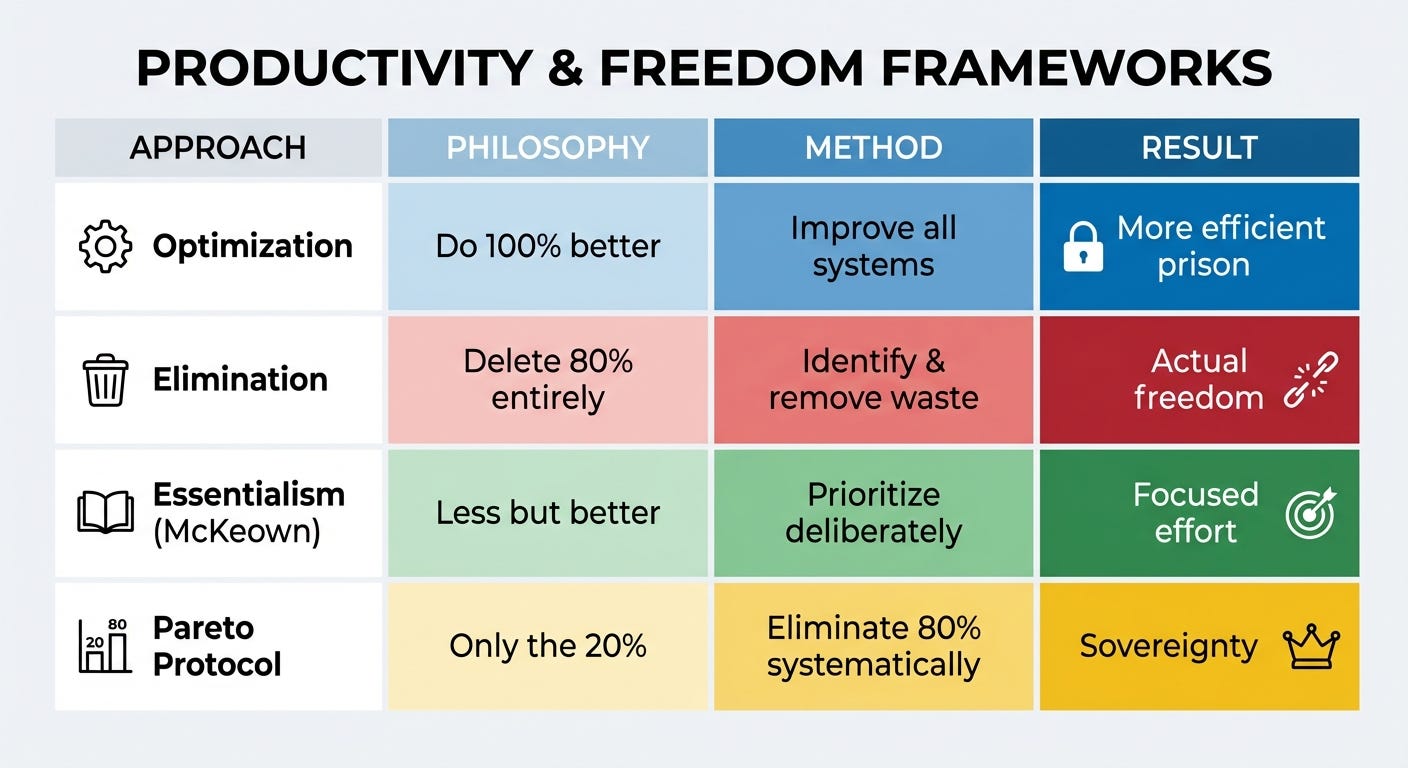
Optimization creates a more efficient prison. Elimination creates actual freedom.
Before you can eliminate 80%, you need the Pareto Protocol Audit to identify your 20%. You cannot delete safely until you know what carries the load.
The Paradox of Choice: Why Abundant Options Create Paralysis, Not Freedom
In April 2020, four months after that night with the spreadsheet, the collapse arrived.
It wasn’t subtle. It was a $468,000 financial loss combined with a medical verdict that stopped me cold. HbA1c: 7.5%. UACR: 135. Stage 2 chronic kidney disease.
I had 47 metrics for health. I had optimized supplements, sleep tracking, and workout variability. And yet, my body was failing.
Why?
The Paradox of Choice.
Barry Schwartz’s research on the paradox of choice demonstrates that abundant options don’t increase satisfaction—they paralyze decision-making and decrease happiness.
When you have 47 metrics, you have 47 decisions to make every day. Did I hit this? Should I adjust that?
This triggers what Roy Baumeister calls decision fatigue. Research reveals that every decision depletes cognitive resources, leading to poorer choices later.
My 47-metric spreadsheet wasn’t a tool. It was a cognitive vampire. Every cell I filled out drained the energy I needed to actually heal.
What is the Paradox of Choice in Productivity?
The paradox of choice reveals that “more” creates “less.” In productivity, this manifests as:
More tools → Analysis paralysis (Which app should I use?)
More strategies → Decision fatigue (Which routine is optimal?)
More metrics → Overwhelm (Am I tracking enough?)
Strategic constraint solves this by eliminating 80% of options systematically. Instead of choosing between 47 strategies, the Pareto Protocol identifies the 20% that matter and deletes the rest. Fewer choices = less paralysis + more energy for execution.
In April 2020, sitting in the wreckage of my finances and health, I asked a heretical question:
“What if 80% of what I was doing shouldn’t have been done at all?”
I stopped optimizing. I started deleting.
I didn’t try to fix the 47 metrics. I deleted the spreadsheet.
I didn’t try to optimize the 15 supplements. I threw 12 in the trash.
I didn’t try to perfect the 90-minute morning routine. I cut it to 20 minutes.
The Ghost screamed. It felt like failure. It felt like giving up. But as the noise quieted, something else emerged: Capacity.
For the first time in years, I had the energy to actually execute on the few things that mattered.
The complete story of this transformation—the forensic breakdown of the financial loss, the medical diagnosis, and the elimination protocol that reversed both—is documented in The Verdict: An Autopsy of a Failed Man. You can get it here, or continue reading for the strategic constraint protocol.
Constraint as Liberation: Why “Discipline Equals Freedom” Means Strategic Elimination
Jocko Willink is famous for the mantra: “Discipline equals Freedom.”
Most people misunderstand this. They think it means “if I rigidly force myself to do hard things, I will be free.” They interpret discipline as punishment.
That is the Ghost talking.
Jocko’s principle is about strategic constraint. By applying discipline (constraint) to your actions, you create freedom (capacity).
If you have the discipline to eliminate sugar (constraint), you gain the freedom of sustained energy.
If you have the discipline to wake up early (constraint), you gain the freedom of time.
The Pareto Protocol takes this further: Strategic constraint equals sovereignty.
We must distinguish between two types of constraint:
1. Arbitrary Limitation (Restriction)
This is restriction without analysis. “I won’t eat carbs because I hate myself.” “I won’t spend money because I’m scared.” This is based on fear and creates deprivation.
2. Strategic Constraint (Sovereignty)
This is deliberate elimination based on data. “I will eliminate these 80% of tasks because they yield zero return.” “I will block my calendar before 10 AM because deep work creates my wealth.” This is based on leverage and creates power.
“Discipline equals freedom” means having the discipline to say NO to the 80% so you have the freedom to say YES to the 20%.
The Application Protocol
How to Apply Strategic Constraint: Domain-Specific Elimination
Strategic constraint isn’t an abstract philosophy. It is a protocol you apply to specific domains. Here is how I applied it to the three areas that were drowning me: Health, Time, and Relationships.
In each domain, the process was the same:
Audit: Identify the 20% producing 80% of results.
Eliminate: Ruthlessly delete the 80% waste.
Systematize: Protect the remaining 20%.
1. Health Constraint: The Supplement Stack
Before Strategic Constraint:
15 daily supplements ($250/month)
90-minute “optimal” morning routine (meditation, journaling, red light, cold plunge)
8 health metrics tracked daily
Result: High stress, low adherence, declining health (HbA1c 7.5%)
After Strategic Constraint:
8 supplements total (The 20% that actually moved the needle)
20-minute morning routine (Walk + Water)
3 metrics tracked (Sleep, Movement, Protein)
Result: Kidney function stabilized, HbA1c dropped to 5.4%, energy surplus achieved.
I realized that the stress of maintaining the “perfect” routine was damaging me more than the routine was helping.
2. Time Constraint: The Calendar
Before Strategic Constraint:
12 recurring meetings per week
3 project management tools (Asana, Trello, Slack)
“Open Door” policy for clients
Result: 12-hour workdays, constant interruption, zero deep work.
After Strategic Constraint:
3 recurring meetings per week (The 20% that drove revenue)
1 tool (Paper planner + simple list)
The Anti-Calendar: No meetings before 11 AM. No calls after 4 PM.
Result: 6-hour workdays, revenue increased, sovereignty reclaimed.
3. Relationship Constraint: The Network
Before Strategic Constraint:
40+ “active” professional relationships maintained
Weekly networking events
Saying “yes” to every coffee chat
Result: Mile-wide, inch-deep connections. Exhaustion. Betrayal by those I tried to please.
After Strategic Constraint:
8 core relationships (The 20% that provided mutual value and safety)
Zero networking events
Hard boundaries on access
Result: Deep, trusted alliances. Protection. Emotional safety.
📊 The Pattern:
Every victory came from elimination, not optimization. I didn’t get better at doing 100% of things—I deleted 80% and mastered the 20% that mattered.
Want the Complete Strategic Constraint Toolkit?
Get the domain-specific elimination frameworks, constraint audit templates, and the “One In, One Out” rule tracker as a downloadable PDF.
Join 15,000+ men using strategic constraint to reclaim sovereignty.
The Elimination Sequence: How to Actually Delete Your 80%
Tim Ferriss pioneered the elimination-automation-delegation sequence in The 4-Hour Workweek. The Pareto Protocol systematizes what Ferriss taught: Elimination isn’t a tactic—it’s the strategy.
Most people—especially Nice Guys running covert contracts—skip elimination. They feel guilty saying no, so they jump straight to “How can I automate this?” or “Can I delegate this?”
If you automate a waste task, you are just doing a useless thing faster.
If you delegate a waste task, you are just paying someone else to waste time.
The protocol must be sequential:
AUDIT: Identify the 20%. The Pareto Protocol Audit is the first step. You cannot eliminate what you haven’t measured.
ELIMINATE: Delete the 80%. If it doesn’t serve the 20%, it goes. No guilt. No justification.
AUTOMATE: Of the remaining 20%, what repeats? Automate it.
DELEGATE: Only after elimination and automation, if it must be done by a human but not by you, delegate it.
Common Mistake: Trying to organize the 80% before eliminating it. Do not organize clutter. Burn it.
Preventing Accumulation Drift: The Quarterly Constraint Audit
Nature abhors a vacuum. When you create space by eliminating, the world will try to fill it.
This is Accumulation Drift.
You delete an app, but three weeks later you download a new one. You clear your calendar, but new meetings creep in. You simplify your finances, but new subscriptions appear.
Strategic constraint requires maintenance. As Cal Newport argues in Digital Minimalism, intentional constraints create depth, but entropy erodes them.
To prevent this, you must run a Quarterly Constraint Audit. Every 90 days, execute this protocol:
Review: Look at your Minimal Tech Stack, your calendar, and your commitments.
Pareto Check: Apply the 80/20 lens. Is this still in my 20%? Or has it become dead weight?
The “One In, One Out” Rule: If you add a new commitment, you must eliminate an old one. This forces prioritization.
⏰ Schedule Now: Add “Quarterly Constraint Audit” to your calendar as a recurring event every 90 days.
Synthesis & Conclusion
Strategic Constraint as Operating System: The Sovereign’s Architecture
Strategic constraint is not just a productivity hack. It is an operating system.
The Ghost operates on an OS of Addition. It believes that more is better, that volume equals value, and that safety comes from controlling everything. It seeks to optimize the chaos.
The Sovereign operates on an OS of Subtraction. It understands that less is powerful, that leverage equals value, and that safety comes from mastering the essential. It seeks to eliminate the chaos.
This distinction is the foundation of the complete Pareto Protocol framework.
Ghost Operating System:
Add more systems
Optimize everything
Complexity as control
Exhaustion as outcome
Sovereign Operating System:
Eliminate 80%
Master the 20%
Simplicity as power
Freedom as outcome
When you shift from Ghost to Sovereign, you stop asking “How can I fit this in?” and start asking “Does this belong?”
You stop trying to be a better juggler. You put the balls down.
The Lighter Pack
December 2019 seems like a lifetime ago. The man staring at that spreadsheet at 11:47 PM was desperate for a better system. He thought if he could just tweak the variables, he could carry the weight.
He was wrong.
I don’t track 47 metrics anymore. I don’t have a perfect morning routine. I don’t have a perfectly optimized life.
I have a life that works. I have a body that healed. I have a business that serves me, rather than me serving it.
The pack is lighter. Not because I got stronger—though I did—but because I finally realized I didn’t have to carry the rocks.
Look at your pack today. Look at the to-do list, the obligations, the “shoulds,” the optimization projects.
You don’t need a better pack. You don’t need to arrange the rocks more efficiently. You need to dump it out.
You need to find your water, your shelter, your fire. Your 20%.
And leave the rest on the side of the trail.
Ready to Eliminate Your 80%?
Get the complete Pareto Protocol framework, weekly insights on sovereignty engineering, and exclusive case studies delivered weekly.
Plus: Read the full transformation story in The Verdict: An Autopsy of a Failed Man—the forensic breakdown of a $468,000 loss, Stage 2 kidney disease, and the elimination protocol that reversed both.
No spam. Unsubscribe anytime. Join our subscribers.
About Wolfe Elher:
Wolfe Elher, M.A. Education, B.A. Psychology, is a sovereignty architect who specializes in elimination-based systems for burned-out high-achievers. After losing $468,000 and receiving a Stage 2 chronic kidney disease diagnosis, he reverse-engineered his operating system using the Pareto Protocol: systematic elimination of 80% waste to focus on the essential 20%. His transformation story is documented in The Verdict: An Autopsy of a Failed Man. He writes about sovereignty engineering at paradigmreset.com.
Continue the Pareto Protocol Series:
• The Pareto Protocol: Why 80% of Your To-Do List Is Sabotaging Your Freedom (Pillar Post)
• The Pareto Protocol Audit: What Your Future Self Would Eliminate Today
• The 3 Must-Dos Philosophy: How the Pareto Protocol Thinks in Threes